Graduate School Semester One
Published:
I am writing this post about halfway into the first semester, as it is only now, in the week before LPSC, that I am establishing this website as a living record of my academic journey.
In the Fall of 2022, I took two classes, and three research credits:
- Lunar Geology, taught by Dr. Shuai Li
- Geospatial Information, taught by Scott Rowland
In the former class, I developed a broad background on the present state of lunar science, including our understanding of the Moon’s formation, minerals, petrology, regolith, composition, and more. I also gave my first presentation in graduate school, based on my progress in radiative transfer modeling of ice-regolith mixtures.
In geospatial information, which was a 400-level undergraduate course, I learned to use ArcGIS. I had previously only known QGIS, which shares many tools but organizes them differently. Since the class, I have returned to mostly using QGIS as my primary, dedicated GIS software. In this class, I also did my first small field trip, taking a GPS unit to Wawamalu to map a burn scar that a fire had left the previous summer (below).
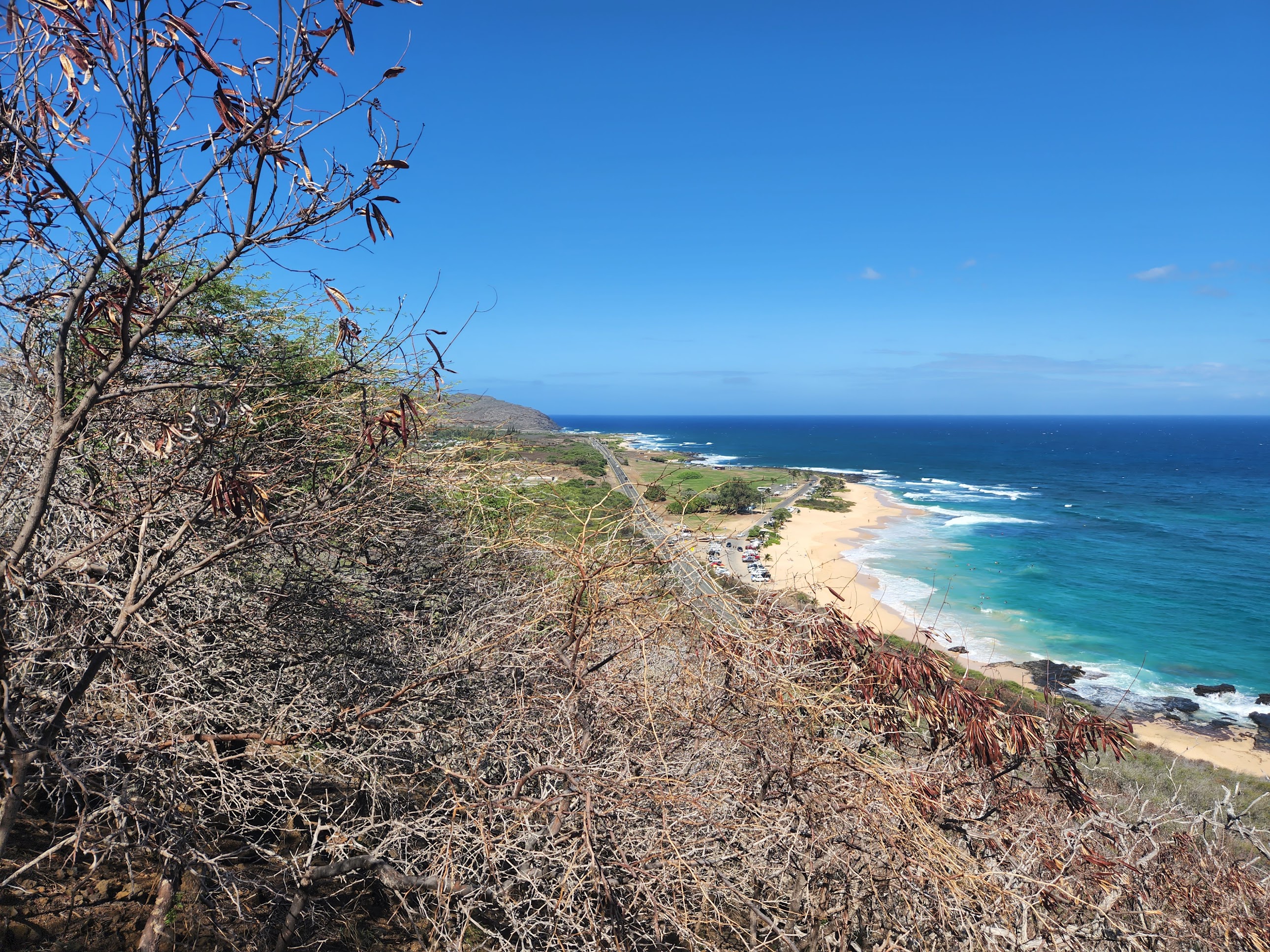
- Caption: View from Wawamalu, on the side of Koko Crater, taken during ERTH 461 field trip. *
New skills, accomplishments, and milestones
- Learned
rasterio,geopandasandshapelyas Python libraries for geospatial analysis - Learned to write Python code as a package for future practical use
- Read papers to gain a better understanding of the history of water-ice detection on the Moon (an ongoing process)
- Applied for the NSF GRFP (results pending)
- Survived first semester focusing entirely on geoscience in classes and research
- Used
seabornand better formatting ofmatplotlib.pyplotplotting tools to create better, more readable graphs. - Joined Huliamahi ideas group, and started work on DEI project with other graduate students
In future posts, that are written more in real-time, this section will also contain goals for the upcoming time.